
Charger topologies explained – CC/CV, multi-stage and beyond
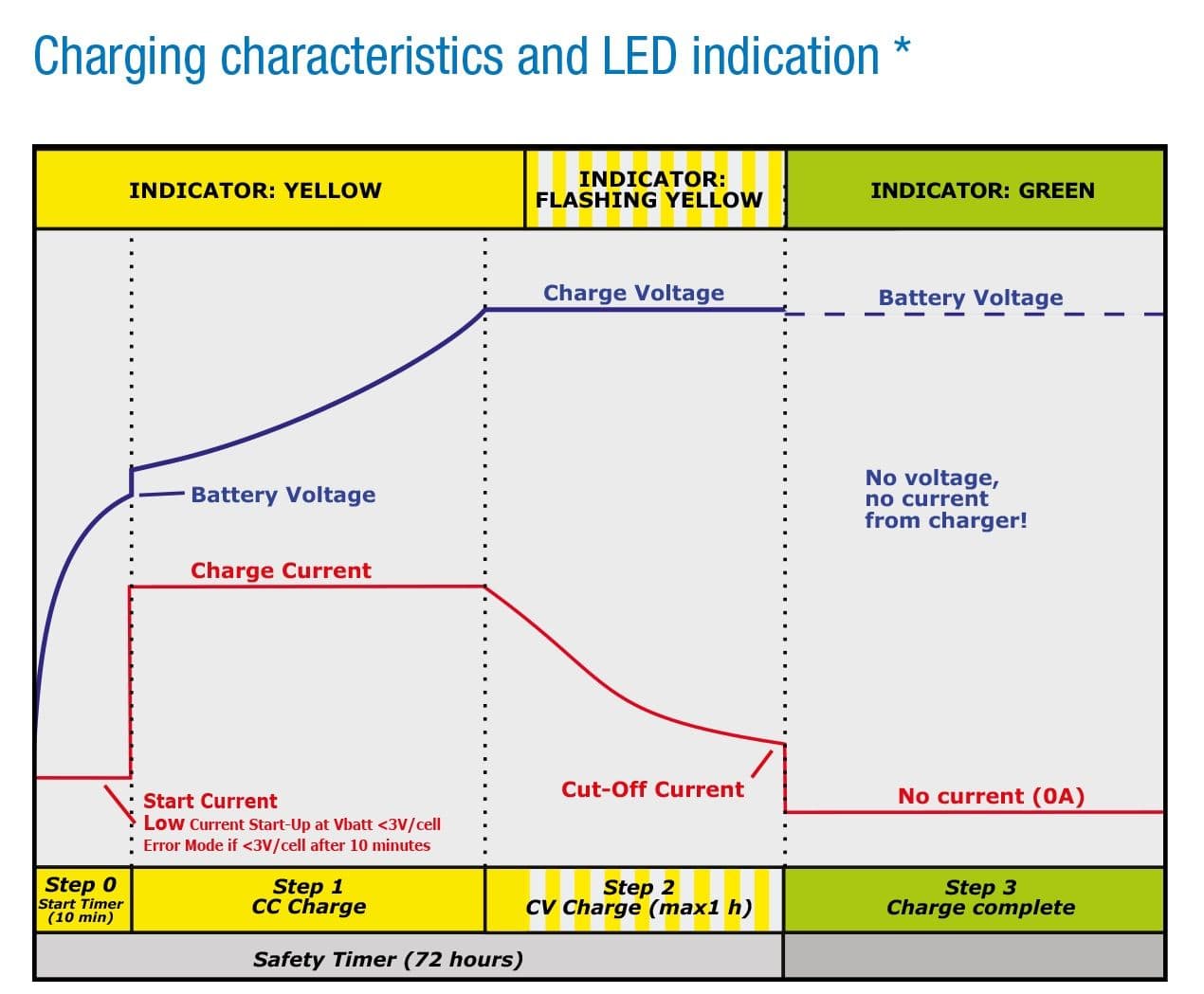
Selecting the right charger topology isn’t simply a matter of meeting voltage and current ratings. For design engineers, the chosen charging method directly affects battery performance, usable capacity, cycle life, thermal behaviour, and overall system reliability. In applications ranging from industrial equipment to medical and mobility products, charger topology becomes a core part of the power architecture rather than a mere peripheral component.
The most widely used approach is constant-current/constant-voltage (CC/CV) charging. At its most basic form, the charger regulates output current to a fixed limit during the initial phase, allowing the battery voltage to rise naturally. Once the battery reaches a predefined regulation voltage, the charger transitions to constant-voltage mode, holding the terminal voltage while the charge current tapers down as the battery approaches full state of charge.
Control is typically implemented using an inner current loop and an outer voltage loop, with loop dominance switching at the CV threshold. CC/CV is simple, predictable, and compatible with most lithium-ion and lead-acid chemistries. However, its fixed transition point and static parameters may not be optimal across temperature ranges, aging states, or varying load conditions.
To improve charge efficiency and battery longevity, many systems adopt multi-stage charging strategies. These introduce additional phases – such as pre-charge for deeply discharged cells, absorption phases for lead-acid batteries, or controlled termination stages – to better manage electrochemical stress. Some implementations will adapt charge current limits or voltage thresholds based on battery temperature, internal resistance, or estimated state of health. Algorithm-driven topologies can dynamically shape the current profile to reduce lithium plating risk at low temperatures or limit gas generation in sealed lead-acid cells. While the approaches described above can deliver measurable gains in usable capacity and cycle life, they increase firmware complexity, validation effort, and system integration overhead. For many products, a carefully tuned CC/CV profile already delivers an optimal balance of simplicity and performance.
Beyond classical CC/CV and multi-stage concepts, high-end charger designs often integrate digital control, communication interfaces, and adaptive control laws to support value-added features. Typical examples include programmable charge curves, telemetry reporting, and closed-loop interaction with a battery management system (BMS).
From a topology standpoint, the power stage (whether linear, flyback, forward, or resonant) plays a major role in achievable efficiency, EMI performance, and thermal behaviour – particularly in high-power or medically approved designs.
Overall, the key engineering trade-offs that influence the choice of charging strategy and circuit design include efficiency versus complexity, control precision versus cost, and adaptability versus validation effort. On the other hand, environmental constraints, regulatory compliance, and long-term availability effectively narrow the design space. Ultimately, for engineers specifying off-the-shelf solutions, understanding these trade-offs helps ensure that the selected charger complements the battery chemistry and meets system-level reliability requirements, at the right price.
Contact Mascot today to discuss your own requirements and explore charger solutions tailored to your application’s needs.